Rooted in Heritage, Rising to the Future
It is difficult to pinpoint an exact title for Kim Pham—the demanding romantic behind Je t’aime Art. As a business owner born in 1986, he immerses himself in every facet of the work, executing each detail to perfection. He will sit with clients for hours, absorbing the unique ebbs and flows of their life stories just to re-imagine them within an event space. He stays up through the night crafting event scripts, ensuring every guest feels woven into the narrative, experiencing a curated spectrum of emotions.
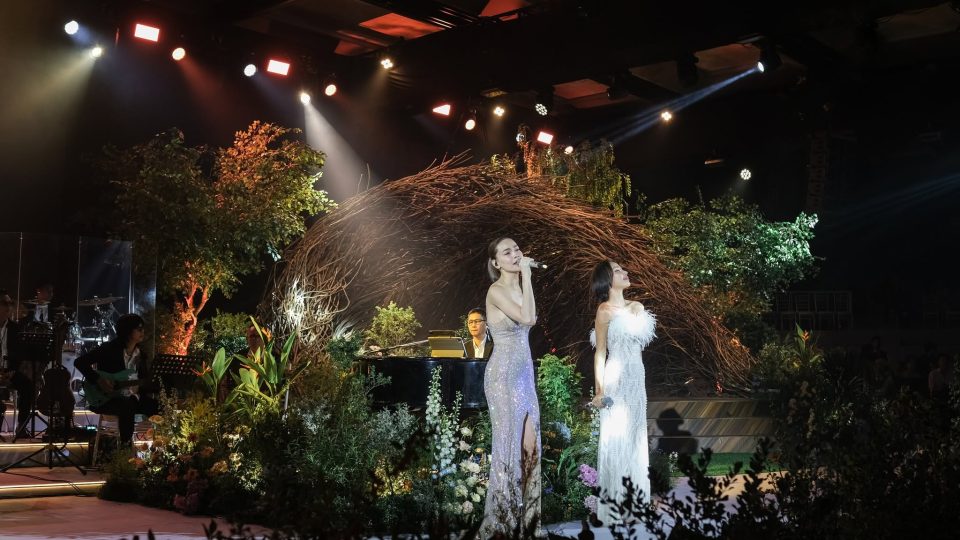
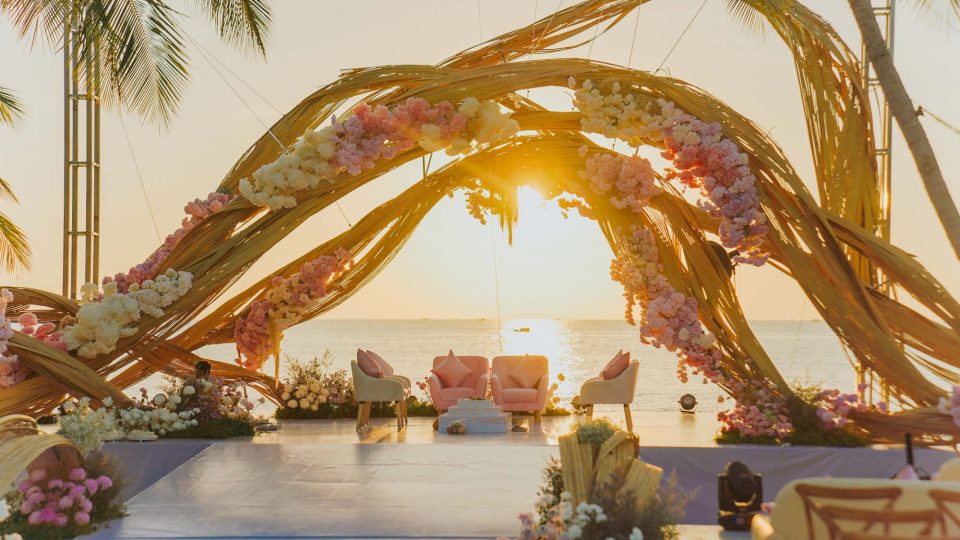
He roams far and wide in search of raw materials to blend and transform into dreamlike spaces. Utilizing traditional sculpting and molding techniques inherited from past generations, he creates structures that leave onlookers marveling, entirely unable to guess the underlying mediums. Yet, like a hopelessly lovesick artist, he can also be found sitting flat on the floor, quietly admiring the stage creations he so meticulously brought to life.
“Vietnam’s cultural heritage and native materials are so vastly diverse that they could never be exhausted.”

Kim chuckles, “There’s also the unspoken job description of sitting and listening to clients vent. Beyond that, I have to convince international clients of the profound layers of meaning embedded within Vietnamese materials. Take an upcoming foreign delegation event in Phu Quoc, for example—it was an uphill battle to help them see why bamboo should be the primary medium to ensure their Vietnamese experience felt authentic and rich. In this line of work, we don’t have a tangible product to show right away; everything relies entirely on the client’s imagination of a space that won’t exist until months later.” He sells dreams, it seems, and business is thriving.
I first encountered Kim at an exhibition he co-hosted under the “Wedding Symphony” initiative. He invested heavily in a singular narrative: events must be experienced through all five senses. What made the project remarkable was not just the harmonious fusion of sight, sound, scent, touch, and emotion into a unified expression of joy; it was Kim’s audacity to invite the entire wedding industry—including direct competitors—to find a collective voice and build a distinct creative identity rooted in Vietnamese culture.
“I believe it’s time for us to sit down together and resurrect a pure, authentic Vietnamese wedding—an event rich with the exquisite nuances passed down by our ancestors, rather than relying on borrowed aesthetics,” Kim shares. “An individual’s creativity may be limitless, but it requires the sturdy foundation of cultural tradition for imagination to truly run wild.”
This was not Kim’s first time attempting the seemingly impossible. For Je t’aime Art’s ninth anniversary, invitations were sent out across the industry, and to everyone’s surprise, the room was full. Kim reflects on the milestone as a moment of profound gratitude—a chance to thank everyone who had walked alongside the brand and contributed to the evolution of the wedding industry as a whole.

“Poetry Doesn’t Pay the Bills”
Kim’s innate understanding of forms and textures stems from his upbringing; he was raised in a family with a legacy of manufacturing and exporting plaster and composite sculptures worldwide, reaching as far as Africa. After graduating from an art institution in Singapore, he initially intended to return home and support the family business. However, a fierce internal drive pushed him out of his comfort zone. Breaking away from the family safety net, the young designer struck out on his own with a mere 7 million VND and a romantic, bohemian dream: the freedom to experiment with the soaring ambitions of youth. He went online, “advertising” his creative solutions, stating that price was no object.
Naturally, life quickly taught him a harsh reality: poetry doesn’t pay the bills.
Kim found himself working tirelessly to clear debts, surviving on instant noodles for months on end. Yet, he still had to maintain an impeccable, elegant front to sell five-star luxury dreams to his elite clientele. “You cannot sell something you don’t fully believe in,” Kim recalls. “Living on instant noodles didn’t matter, as long as I woke up every day thrilled by new ideas, shivering with excitement while sketching event spaces that would move clients to tears because they captured exactly what their hearts desired.”
His portfolio is a testament to this devotion: a wedding set deep within a wild forest; a shadow-dance performance translating a couple’s turbulent love story; a magic act performed by the groom himself; and a breathtaking replica of a multi-generational ancestral chapel, meticulously reconstructed entirely from the memories of elders. Even a traditional, ostensibly simple “Hỷ” (Joy) character is elevated into a lavish, elaborately crafted centerpiece. In the realm of luxury, true distinction lies in the smallest, most fiercely guarded details—a truth vividly illustrated by Kim’s work.
Today, the Je t’aime Art team has long outgrown the days of surviving on instant noodles. They now embark on international journeys to refresh their perspectives, touching historical architecture that once existed only in their imaginations. The dream Kim Pham weaves is no longer just for his clients; it is for his team.
Showing the inside of his wrist, Kim points to a small cluster of numbers tattooed in the corner. He explains that he is leaving space for the next meaningful milestones of his life—perhaps “9 + 5,” the chapter where Je t’aime Art executes the second phase of a grander vision: connecting Vietnam’s creative event industry into a closer, more unified ecosystem.

A Lifelong Devotion to the Creative Soul
“Creativity is seeing what others see and thinking what no one else has thought,” Albert Einstein once noted. In a world increasingly dominated by artificial intelligence, many argue that creativity remains the final fortress shielding humanity. Looking at Kim, I am reminded of the arduous journey he and other unsung heroes of the creative industry endure.
When speaking of his “9 + 5” ambition, the exact blueprint for putting Vietnam’s event industry on par with global giants like the Middle East—a region famed for its emotionally overwhelming event scales—remains fluid. Yet, Kim possesses an unshakeable faith in his destination because he knows his methodology is sound: leaning into the bedrock of Vietnamese tradition and choosing to walk this path in tandem with others.
I am reminded of a microscopic detail from one of Kim’s past events: the use of traditional relief techniques on stone structures to create a three-dimensional illusion on a completely flat surface. It was a minor element, yet it beautifully echoes Steve Jobs’ cosmic perspective: “Creativity is just connecting things.”
Kim Pham has successfully mastered the art of selling dreams, seamlessly transforming raw materials and deep cultural narratives into the high-stakes world of avant-garde event design.
From: Bung Trần